
Imagine a customer in Limpopo calling her internet provider for the third time. Speaking in Tshivenda and English, she explains that her router has already been replaced. The AI-generated handover says it still needs replacing. The agent finishes the call on time. Tomorrow, a technician may arrive with another router.
Which figure will the executive team see first—the shorter call or the unnecessary visit?
The answer depends on choices leaders make before anyone switches on the software. If agents are recognised for ending calls quickly while correcting an inaccurate summary counts against their handling time, the organisation has created an incentive to pass the error down the line. Fixing that incentive is part of introducing AI, just as much as choosing the technology.
What counts as local?
The World Bank’s Digital Progress and Trends Report 2025 describes four foundations for AI adoption: connectivity, computing power, local context and skills. For a smaller business, these become practical purchasing questions. Will the service work on the connection a branch can afford? Can it handle the languages customers use? Once licences, data and staff review time are included, can the organisation afford to run it well?
South African language technology offers a concrete example. Lelapa AI’s model card for its Vulavula RSA English transcription model specifies a call-centre use case and South African English. That does not establish capability in every language or code-switching pattern. Before signing a contract, test the exact calls and language mix the service is expected to handle—including a caller who changes language while explaining the fault.
Who knows the work?
The 2026 India AI Impact Summit compendium describes Digital Green’s FarmerChat pilots launching in India and Kenya in October 2023 through agricultural extension workers. The service was co-designed with women farmers and was built to provide localised advice in different languages and formats. Where locally vetted information exists, it can ground responses; critical questions can be directed to human experts. The organisational lesson is straightforward: people who understand how advice is sought and used should help shape how it is delivered.
Apply that principle to the internet provider. Invite the agent who handles mixed-language calls and the technician who acts on the handover to design the trial together. The agent can spot a mistranslation. The technician can explain why one wrong verb may send a crew back to the same address. Give both a way to flag recurring errors and a supervisor who can change the workflow in response.
That is also a job-design decision. The International Labour Organization’s 2025 research finds that most occupations contain tasks requiring human input, making transformation of work more likely than complete automation. Leaders therefore choose what fills the time a tool frees up. A contact-centre supervisor, for example, could use some of it to pair agents with technicians to investigate repeat faults.
A graphical framework for choosing where to begin
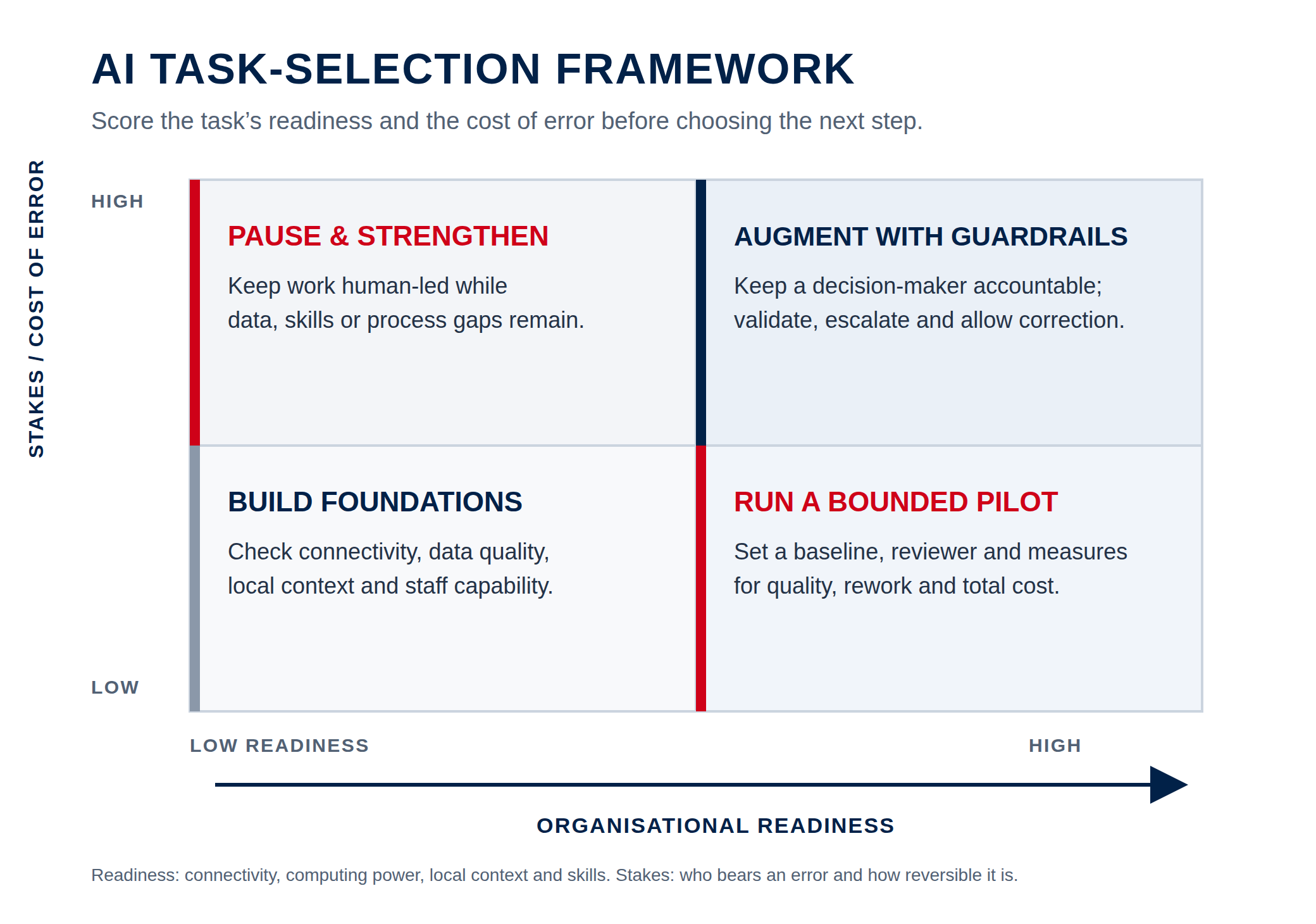
Assess one task at a time. Readiness asks whether the organisation can support the tool under local working conditions. Stakes asks who bears the cost of an error and how easily it can be corrected. The matrix turns those two questions into a sensible next step.
Download the AI task-selection framework (PNG)
How to use the matrix
- High stakes, low readiness: Pause automation. Keep people responsible for the work while the organisation closes data, skill or process gaps.
- High stakes, high readiness: Use AI only as supervised support. Keep an accountable decision-maker, validation, escalation and a way to correct errors.
- Low stakes, low readiness: Build the foundations first: connectivity, data quality, local-language fit and staff capability.
- Low stakes, high readiness: Run a bounded pilot with a baseline, a named reviewer and measures for quality, rework and total cost.
What would justify a wider rollout?
Before the pilot, establish what it takes to resolve a fault today. Compare similar cases and count repeat calls, unnecessary dispatches, staff time spent checking summaries and total cost per resolved fault. Examine results by language. Ask the evening shift who is still correcting handovers after the day team has gone home; their answer belongs in the business case.
If calls get shorter while repeat visits rise for a language group, pause expansion and review those handovers with the people who handle them. If service quality improves across language groups and the cost is sustainable, expand one team at a time. The clearest test belongs to the customer who has already had her router replaced: on her next call, does the organisation remember what it has already done?
Sources
- World Bank, Digital Progress and Trends Report 2025: Strengthening AI Foundations
- Lelapa AI, Vulavula RSA English transcription model card
- India AI Impact Summit 2026 Compendium, FarmerChat case study
- International Labour Organization, Generative AI and Jobs: A Refined Global Index of Occupational Exposure (2025)