
Imagine a resident reporting that the communal tap runs dry every morning before school. A municipal crew visits at noon, turns the handle and sees water. The crew’s observation is accurate. So is the resident’s. The trouble starts when someone marks the case resolved.
The most important detail in the report was before school. Those two words should shape the work order, the inspection time and the decision to close the case. They also give a municipal manager a practical service-design test: can the institution carry what a resident knows all the way to the person who can act on it?
Design the service with the people who use it
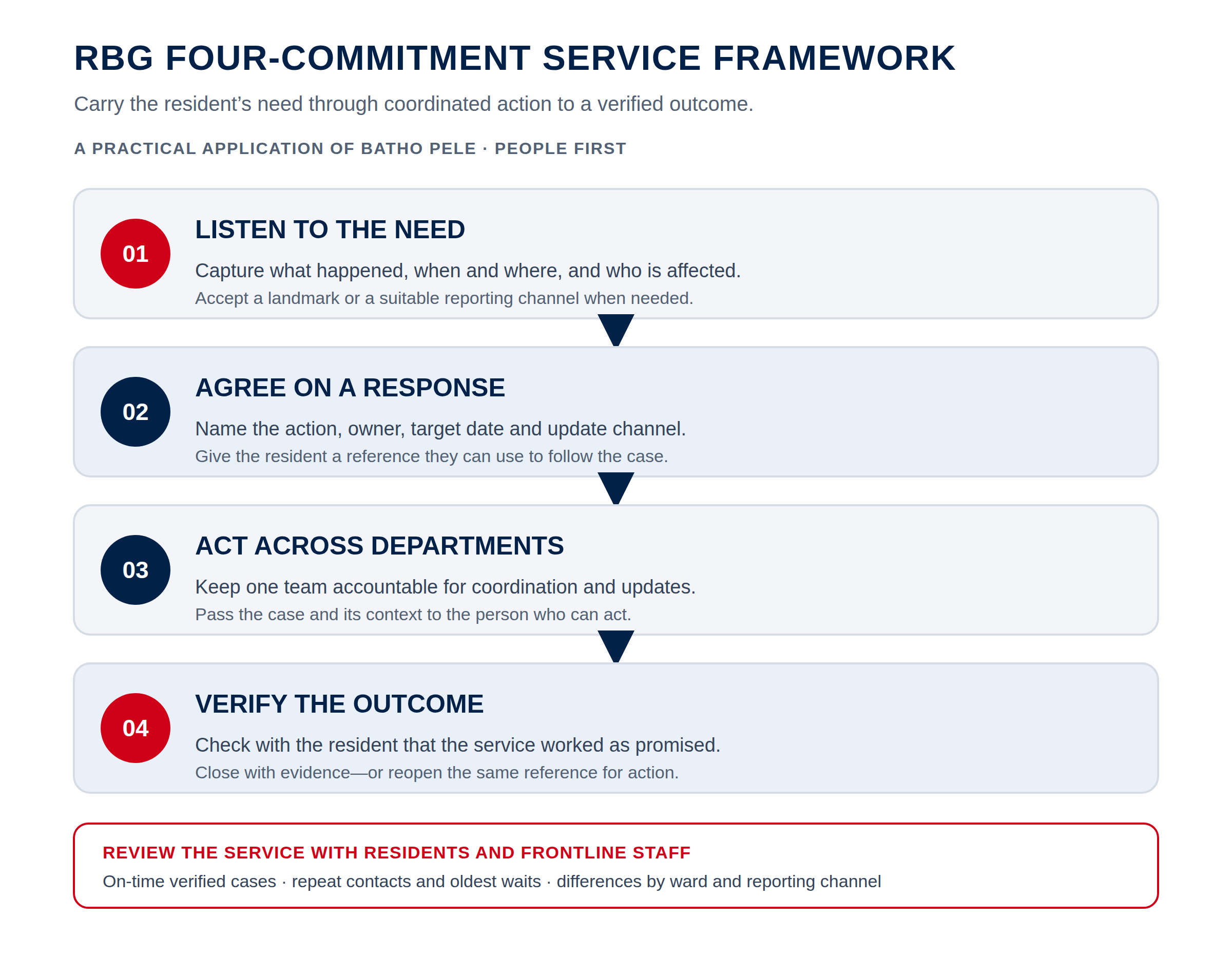
South Africa’s 1997 Batho Pele White Paper set out eight principles for public-service delivery, including consultation, access, service standards and redress. RBG’s proposed framework turns those principles into four everyday commitments: listen to the need, agree on a response, act across departments and verify the outcome.
Start at the tap. Ask the people who collect water what a successful repair would look like. Ask someone who has never reported the fault how they would do it. One resident may know the tap by a taxi rank rather than a street number. Another may share a phone and miss the only callback. These conversations identify specific changes: accept a landmark, agree on a suitable update time and let the resident choose how to receive the response.
Keep responsibility with the institution
The City of Cape Town’s published service-request process offers several reporting channels, issues a reference number for follow-up and lets residents dispute a closure when work is incomplete. That gives a resident a way to report and query a case. It does not remove the institution’s responsibility to coordinate the work.
For a manager designing a similar service, the harder decision comes after the first call. If the depot needs an engineer, who arranges the handover? Who tells the resident when to expect an update? Give one team responsibility for both. The resident has already supplied the location, timing and effect on the household; the municipality should coordinate its response without making the resident chase each department.
The four-commitment framework
Each commitment is paired with a question the resident can answer. At verification, the institution closes the case only when there is evidence the service worked—or returns it for action under the same reference.
Download the citizen-centred service framework (PNG)
- Listen: What happened, when and where, and who is affected?
- Agree: What will the institution do, by when, and how will the resident receive an update?
- Act: Which team coordinates the work across departments under the same case reference?
- Verify: Did the service work in the conditions the resident reported? Close with evidence or return the case for action.
Measure what changed for the resident
If a depot supervisor is assessed on the number of work orders closed, a noon inspection can look like success. Give that supervisor authority to reopen a disputed case. At the monthly review, bring the contact centre and depot together to account for three things:
- Was service completed by the promised date? Report the share of cases due that month which were resolved and verified on time. Keep overdue cases in the denominator.
- Who carried the follow-up cost? Count repeat contacts and review how long the oldest unresolved cases have waited.
- Whose experience is missing? Compare results across wards and reporting channels. Few complaints may mean the service is hard to access, not that it works well.
South Africa’s citizen-based monitoring framework treats residents’ experience as evidence for improving frontline services and describes feedback as an iterative link to service improvement. Bring residents and frontline staff together to review recurring faults. If morning reports repeatedly receive midday inspections, change the dispatch schedule, name the responsible manager and tell the community when the change will be reviewed.
The same approach can support a licensing office, where an applicant needs an understandable decision, reasons and a route to query it. At the communal tap, the test is simpler: when families arrive before school tomorrow, can they fill their containers?
Takeaway: Listen to the person experiencing the service, keep coordination with the institution and verify the outcome before closing the case.