

Consider a graduate estimator who takes two taxis from Tembisa to an engineering office in Midrand. Tuesday is the team’s office day. She brings a tender and one question: how much labour should she allow for an unfamiliar job? Her supervisor is at a client site. Two video calls later, the estimate is still waiting.
Both have followed their schedules. What is missing is the half-hour in which the graduate can watch her supervisor work through the estimate, question an assumption and explain why it matters. That half-hour is worth designing the week around. Once it is booked, she can finish the quotation wherever she can concentrate and meet the deadline.
What is shared time worth?
A six-month randomised trial at Trip.com in China followed 1,612 graduate employees offered two work-from-home days a week. The quit rate was 4.8% for the hybrid group and 7.2% for office-based colleagues—a 2.4 percentage-point difference. Performance grades remained comparable over the following two years. The result is specific to the employees and roles studied; it is evidence to consider, not a guarantee for every workplace.
A separate study of software engineers at one large firm found that sitting near teammates increased feedback on code, with the gains concentrated among younger and less-tenured employees. Experienced engineers wrote less code themselves when seated near colleagues. If a firm wants graduates to learn from senior staff, it should plan mentoring time and recognise that work in senior employees’ workloads and performance reviews.
Design the week around the work
The same employee may need three arrangements in one week: a client site to take measurements, time beside a colleague to work through a difficult pricing decision, and an uninterrupted afternoon to draft a quotation. Each activity gives the manager a reason for choosing where it happens.
Nedbank’s 2025 Society Report describes group guidance encouraging two to three office days a week, while business areas shape arrangements around their work. It also describes adjusted working hours and role-appropriate remote flexibility. A field technician may need to attend a client site, but advance notice of assignments or the ability to swap shifts can still provide meaningful control over the week.
Make the team agreement explicit
A useful hybrid agreement fits on one page. It states who covers urgent client calls, when colleagues need to be available, and where decisions and handovers are recorded. It also tells a graduate when feedback is available and gives someone with unreliable home connectivity access to a suitable desk.
Managers should make access to career-building work deliberate. When a client presentation comes up, consider everyone who contributed to the proposal—including the analyst who completed the costing remotely. Publish the selection criteria and give the chosen employee time to prepare. That makes opportunity a management decision, not a matter of who happened to be nearby.
Test the arrangement against results
At the engineering firm, an eight-week pilot could track three measures from the start:
- Quotations delivered on time.
- Estimates returned for correction.
- Time junior staff wait for technical review.
Compare tenders of similar complexity. Ask site staff who absorbed urgent calls and what work they had to put aside. If turnaround improves because one technician quietly picks up every interruption, adjust the cover roster before expanding the model. Review whether junior staff can get coaching and whether career opportunities are shared fairly.
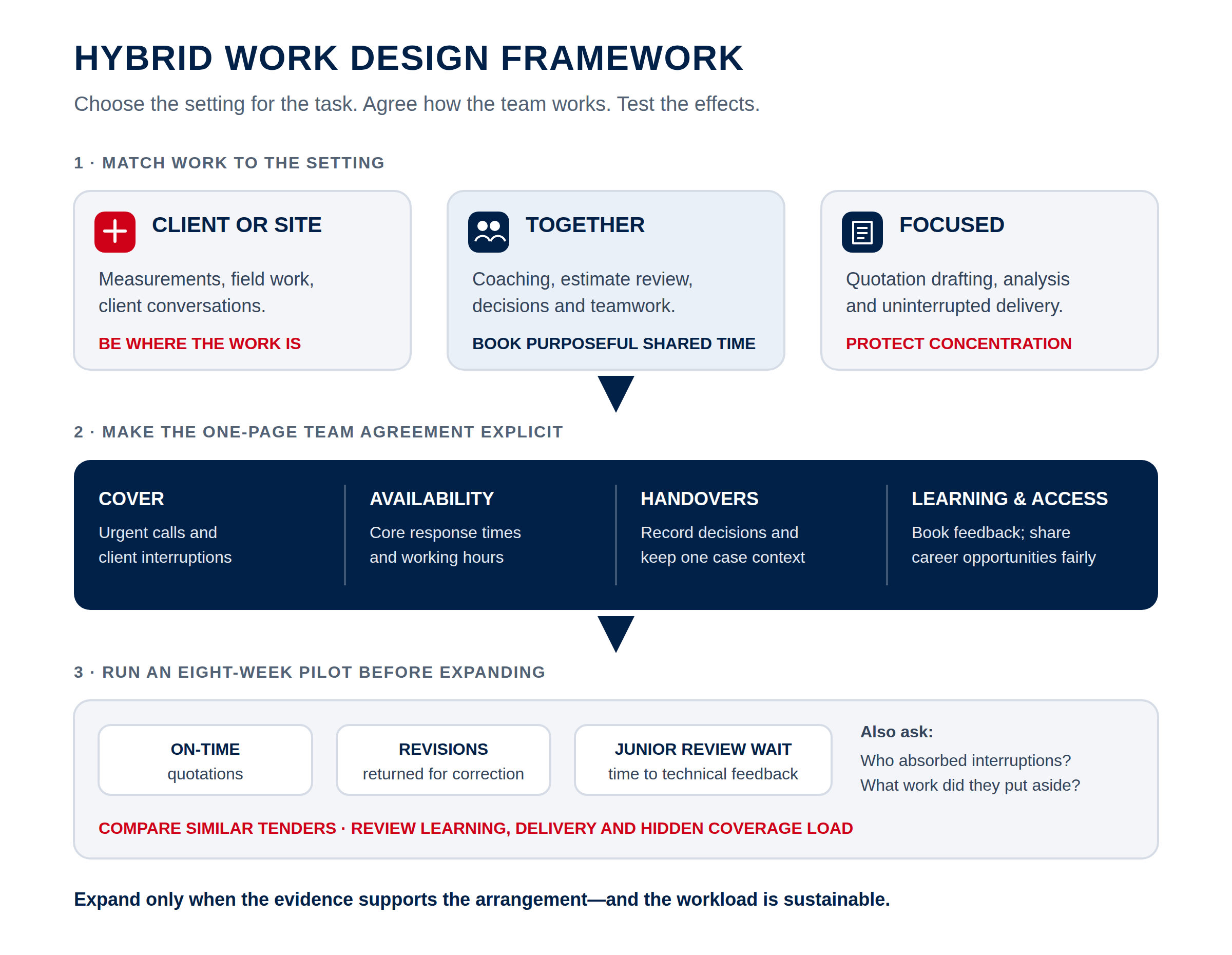
Download the hybrid-work design framework (PNG)
At the end of the pilot, give the graduate a fresh tender. Can she price the labour, explain her assumptions and recognise when to ask for help? Her answer tells the firm what it gained from bringing two people together on a Tuesday.
Takeaway: Make shared time purposeful, preserve room for focused work and protect the coaching and access the team needs. Agree how work gets done, then review evidence before scaling the arrangement.