
When floods halted assembly at Toyota South Africa’s Prospecton plant in April 2022, recovery came in stages. The Hino truck plant restarted on 24 May. The Hilux and Fortuner lines followed on 21 July. For a dealer waiting on a Hilux, the date that mattered was the one on which Toyota could deliver that vehicle.
That distinction belongs in the boardroom. When an executive reports that supply has recovered, the CEO should ask: which customer orders can now be filled, in what quantity and by what date? The answer gives sales a promise to make and operations a commitment to test.
Find the dependency that could stop delivery
A supplier’s place on the spending list can be misleading. MIT’s analysis of Ford’s supply chain found that some suppliers of relatively low-cost components could pose the greatest potential threat to profit if deliveries stopped. A part may cost little and still determine whether a finished product can be delivered.
Choose one product customers depend on and trace an order backwards. Ask procurement where each critical component is made. Two approved distributors may rely on the same factory, specialised tool or shipping route. Before paying for a second source, establish which disruption it would protect against. Then place a trial order and check what arrives, in what condition and how long it takes.
Put two recovery times on the board agenda
Time to survive (TTS) is how long the supply chain can continue matching supply with demand after a specific site or route fails, using available stock and alternatives. Time to recover (TTR) is how long that disrupted part of the network needs to return to operation. Compare both for a specific product and test the assumptions behind each estimate.
A supplier may quote the date its equipment restarts. A customer needs to know when inspected goods will reach the delivery point. Include production, quality checks, transport and any booking or approval time in the recovery estimate.
Framework: measure the delivery gap
In this illustrative packaging example, a manufacturer has 4,000 usable cartons and needs 500 each day. Its stock covers eight days. If usable replenishment takes 12 days to arrive, the business has four uncovered days—or 2,000 cartons of exposed demand.
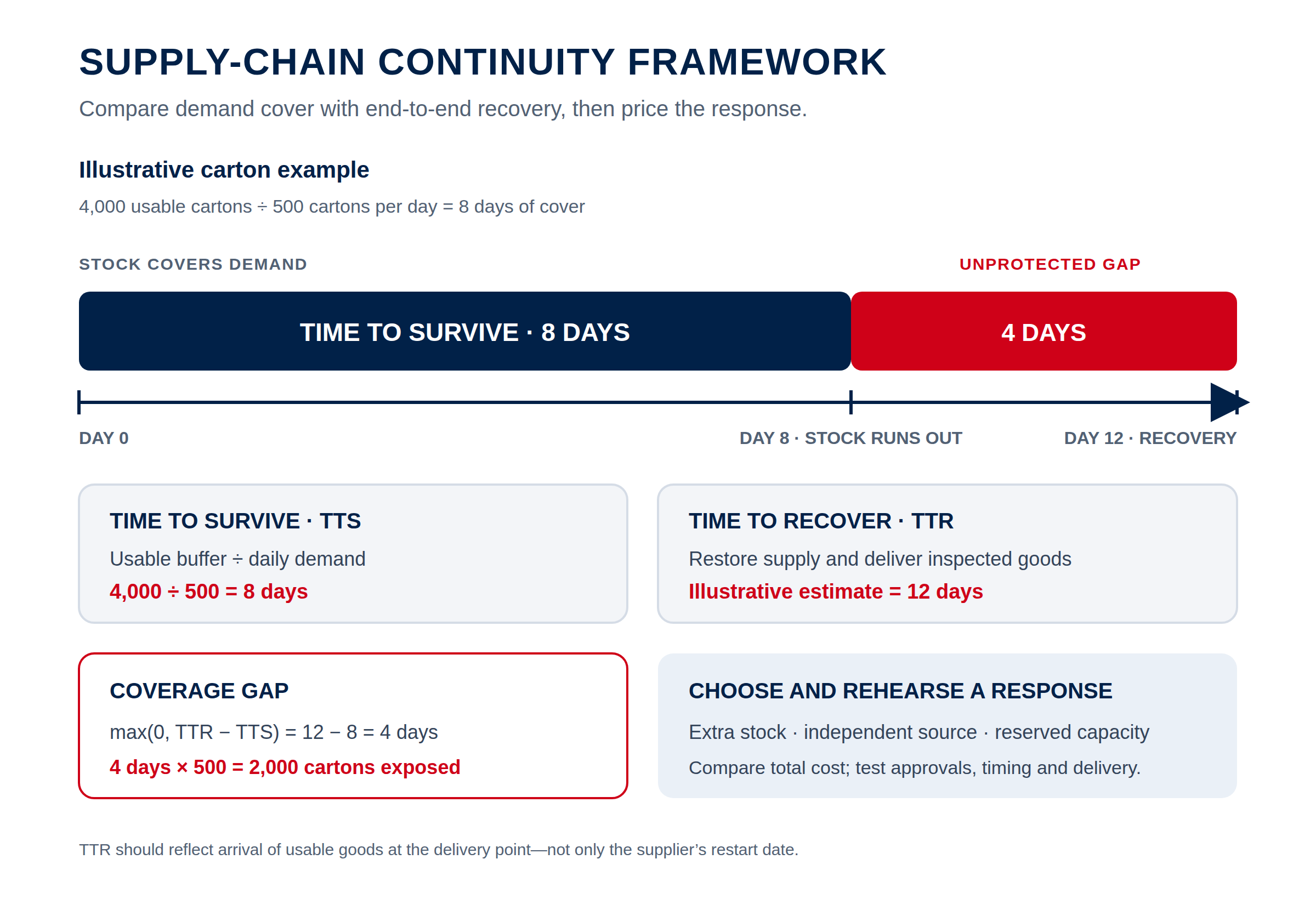
Download the supply-chain continuity framework (PNG)
The gap makes the investment choice concrete: hold another 2,000 cartons, or qualify an independent supplier that can deliver 500 a day from the start of day nine. The right choice depends on cost, product changes, supplier reliability and how much delivery exposure the business is prepared to accept.
Give finance and operations the same question
A buyer rewarded for a lower unit price may struggle to justify a second supplier. A finance manager tasked with releasing working capital may reduce the stock that gives production time to recover. Both can meet their targets while customers wait. The CEO’s shared question is: what will it cost to keep our delivery commitment, and what exposure are we prepared to accept?
Finance can quantify cash tied up in extra stock, storage costs and the risk of a write-off if packaging changes. Procurement can establish what a second supplier charges to reserve capacity. Sales can identify which missed deliveries would delay a customer’s own production. Those answers help the executive team compare reserves, alternative sources and contracted capacity.
Rehearse the decision before disruption
Tell the team the packaging supplier has lost its plant and the carrier’s booking window closes at noon. Who can approve additional freight? Which customers receive the remaining cartons? Who contacts the customer whose order will be late? Record when each decision is made. If the team waits for a signature, the organisation has found a weakness that buying more stock alone will not fix.
Takeaway: Protect delivery promises by mapping critical dependencies, comparing TTS with end-to-end TTR, weighing mitigation costs and rehearsing who decides. Report recovery in customer orders and dates—not only supplier restart milestones.