
A shopper brings last week’s bag back to the till. The retailer sells groceries, the shopper saves the price of another bag, and the first bag works a second time. For a board considering an environmental, social and governance (ESG) investment, which of those outcomes should count as success?
Connect the opportunity to a business decision
Woolworths announced in 2022 that it had removed single-use plastic shopping bags from its South African foodmarkets. The change required an affordable, durable alternative that could be manufactured locally. Woolworths reported that a Black-owned supplier it partnered with grew from 118 employees in 2019 to 302 three years later. A change in what a major buyer purchased created a growth opportunity; the local manufacturer built capacity to supply it.
That is a concrete business connection, not proof that every sustainability initiative will grow revenue. Leaders should ask which buyer might place an order, whether a customer contract is at risk, if better resource use could improve margin, and what evidence would justify a larger investment.
Measure outcomes, not just activity
Woolworths Food reported selling 39.2 million reusable bags in 2024. That measures demand and scale; it does not, by itself, establish environmental benefit. To assess that, leaders need to know how often each bag is reused and what it replaces. The United Nations Environment Programme’s review of shopping-bag life-cycle studies finds that the number of uses directly affects environmental impact.
Woolworths also reported a 2022 bag-sharing trial at four stores. Customers could leave spare bags for other shoppers to use. A store manager rewarded only for selling new bags could have an incentive that conflicts with reuse. The performance measure can work against the purpose of the investment. Track reuse and customer behaviour alongside sales instead of treating bag volume as the whole outcome.
Bring ESG into the strategy meeting
IFRS S1 asks which sustainability-related risks and opportunities could affect cash flows, access to finance or the cost of capital. Ask those questions while leaders can still change an investment: Is a buyer ready to place a repeat order? Has a lender offered different terms? Could reduced waste free production capacity for another customer?
Keep the sources of value distinct. A new customer may add revenue; retaining a contract protects it; lower electricity use may improve margin. Recording all three as “sales growth” obscures what earned the return and where the next investment should go.
Test both the return and the impact
Consider a separate, illustrative case: a workwear manufacturer wins an order for 1,000 aprons made with recycled fabric. The selling price is R120 per apron, variable costs are R90, and testing and setup cost R15,000.
The order produces R120,000 in revenue and R15,000 contribution after setup, before overheads, financing and tax: 1,000 × (R120 − R90) − R15,000. At R30 contribution per apron, 500 aprons recover the setup cost.
Before adding a shift, the managing director still needs evidence: Will the buyer reorder at that price? Did the new order displace more profitable work? Can procurement verify the recycled content, and does the apron last as long as the one it replaces? What happened to overtime and pay as production increased?
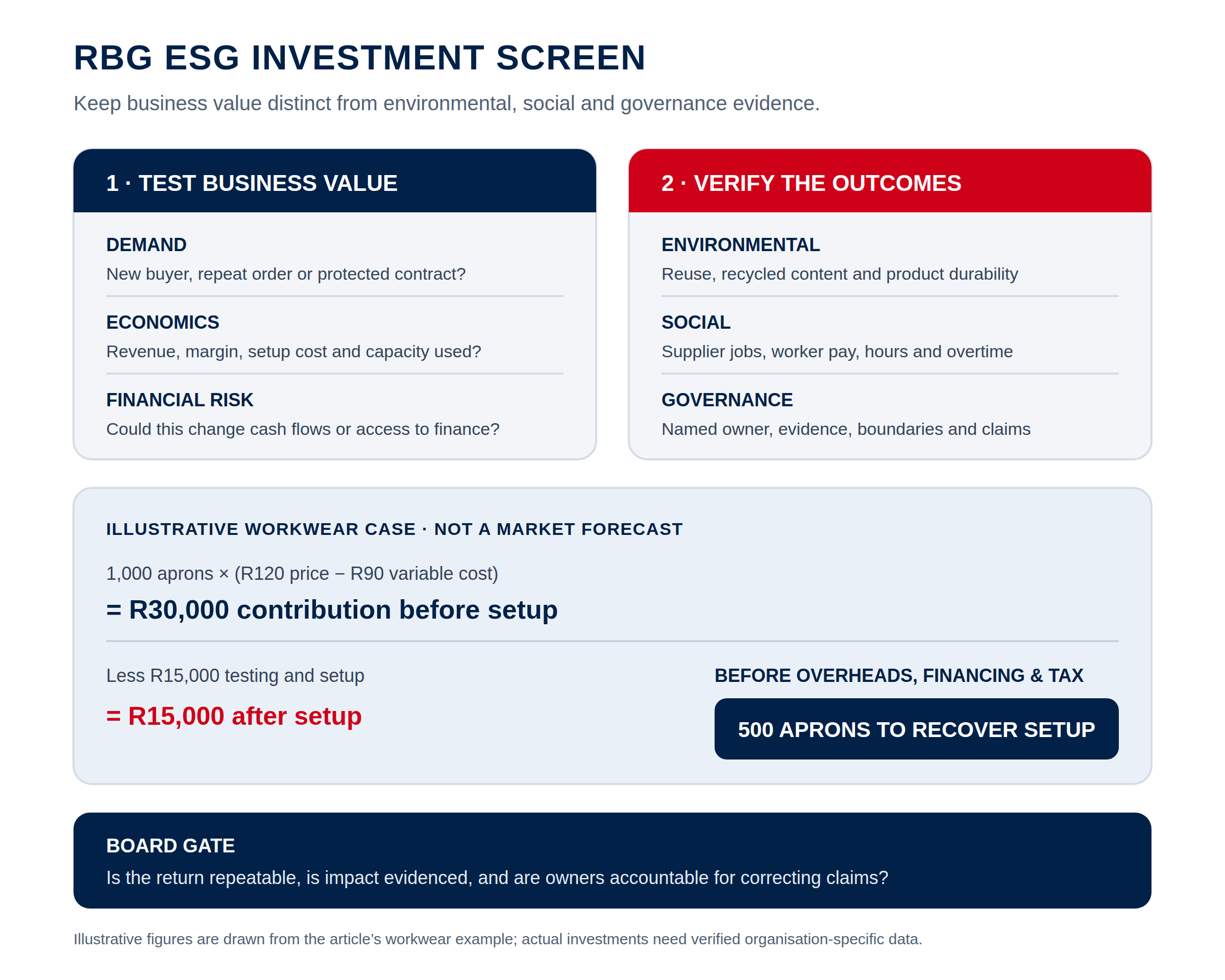
Download the ESG investment decision framework (PNG)
These questions need owners. Sales checks for repeat orders. Operations tests durability. HR reviews pay and hours with the production team. Finance checks margin, and the person approving a public claim has authority to correct it. At the next investment meeting, the board can review what the business earned, who benefited and whether the evidence supports expansion.
Takeaway: Treat ESG as an investment decision, not a label. Track commercial value separately from environmental and social outcomes, assign owners and scale only when the evidence supports both.
Sources
- Woolworths Holdings, removing single-use plastic bags from foodmarkets (2022)
- Woolworths Holdings, 2024 Good Business Journey Report
- UNEP, Single-use plastic bags and their alternatives: recommendations from life-cycle assessments (2020)
- IFRS S1, General Requirements for Disclosure of Sustainability-related Financial Information